

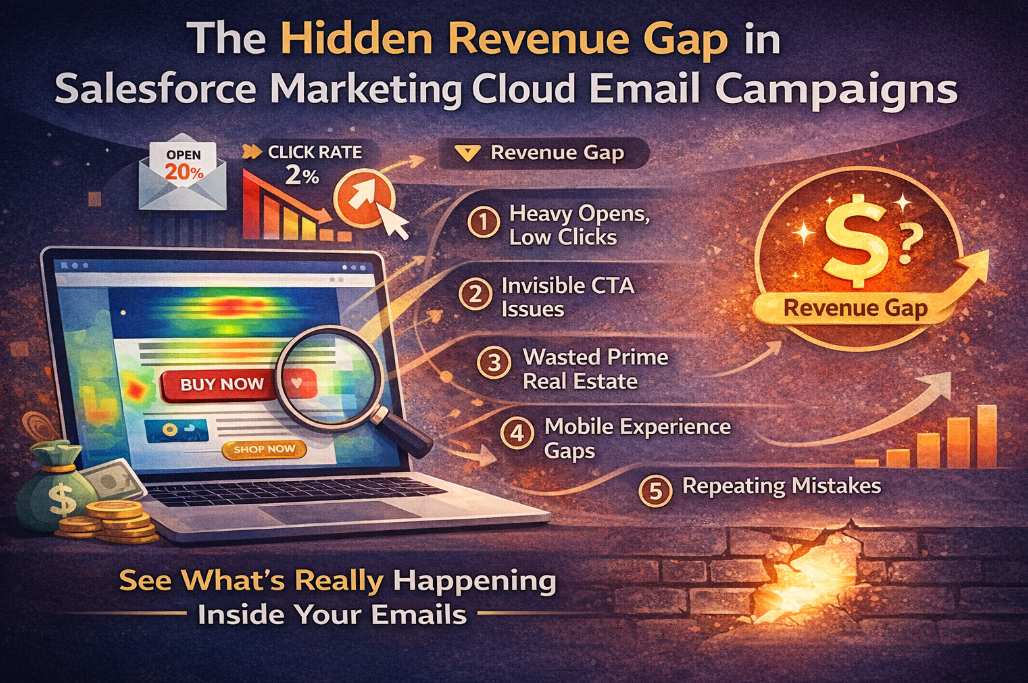

The Hidden Revenue Gap in Salesforce Marketing Cloud Email Campaigns
On paper, your email campaigns in Salesforce Marketing Cloud are performing.
- Open rates look healthy
- Click rates seem stable
- Reports show steady engagement
But here’s the uncomfortable truth:
You’re leaving revenue on the table—and you don’t even know where.
The Illusion of “Good Performance”
Most CRM teams measure success using:
- Open rate
- Click-through rate (CTR)
- Conversion rate
These metrics give you a surface-level view.
They tell you what happened—but not why it happened.
So when performance drops or plateaus, you’re left guessing:
- Was it the subject line?
- The design?
- The offer?
Without clarity, optimisation becomes trial and error.
Where the Revenue Gap Actually Exists
The real gap sits between:
👉 User intent (opens)
👉 User action (clicks & conversions)
This gap is driven by unseen behaviour inside your email.
You don’t know:
- Which sections users focus on
- Which CTAs attract attention
- Which elements are completely ignored
- How users interact across different layouts
And that’s where revenue is lost.
5 Hidden Revenue Leaks in SFMC Email Campaigns
1. High Opens, Low Clicks
You’ve done the hard part—getting users to open.
But once they’re inside:
- They don’t find what they expected
- They don’t see a clear next step
- They don’t engage
👉 Result: Lost opportunity after open
2. Invisible CTA Performance Issues
You may have multiple CTAs, but:
- Which one performs best?
- Which one gets ignored?
- Are they competing with each other?
Standard reporting won’t tell you this.
👉 Result: Suboptimal click distribution
3. Wasted Prime Real Estate
The top section of your email (above the fold) is the most valuable.
But often:
- It’s used for branding instead of action
- It lacks a strong CTA
- It doesn’t guide users effectively
👉 Result: Missed high-intent clicks
4. Mobile Experience Gaps
Most SFMC emails are opened on mobile.
Yet:
- Layouts are designed for desktop
- CTAs are hard to reach
- Content is not optimised for quick scanning
👉 Result: Friction → fewer clicks → lower revenue
5. Repeating the Same Mistakes Every Campaign
Without deep insights:
- Learnings don’t carry forward
- Teams rely on assumptions
- Performance stagnates
👉 Result: Long-term revenue loss
Why Traditional SFMC Reporting Falls Short
Salesforce Marketing Cloud provides strong campaign reporting—but it stops at aggregated metrics.
You can see:
- Total clicks
- Total opens
- Link-level performance
But you can’t see behaviour visually.
You don’t know:
- Where users clicked most
- Which sections drove engagement
- How layout impacted performance
That missing layer is the revenue gap.
The Real Impact of This Gap
Let’s quantify it.
If your campaign delivers:
- 200,000 opens
- 2% CTR → 4,000 clicks
Now imagine improving to just 2.8% CTR:
- 5,600 clicks → +1,600 additional clicks
That’s a 40% increase in traffic from the same audience.
No extra spend. No extra sends.
Just better optimisation.
What High-Performing Teams Do Differently
Top CRM teams don’t rely only on standard metrics.
They focus on:
- Behaviour-driven optimisation
- Continuous layout improvements
- Data-backed design decisions
- Faster post-campaign insights
They don’t just measure performance—they understand it.
Closing the Gap with Behavioural Insights
To close the revenue gap, you need to answer:
- Where do users click first?
- Which sections drive engagement?
- What gets ignored completely?
- How does layout influence behaviour?
This is where most teams struggle.
How CRMX Unlocks Hidden Revenue
CRMX bridges the gap between data and behaviour.
Instead of just numbers, you get:
- Visual click heatmaps on your emails
- High vs low engagement zones
- CTA-level performance insights
- Real interaction patterns
This enables you to:
- Optimise layouts with precision
- Increase CTR without redesign
- Prove impact to stakeholders
- Drive measurable revenue growth
Final Thought
Your email campaigns aren’t failing.
They’re just not fully optimised.
Because until you understand how users interact inside your emails, you’ll never unlock their full revenue potential.